
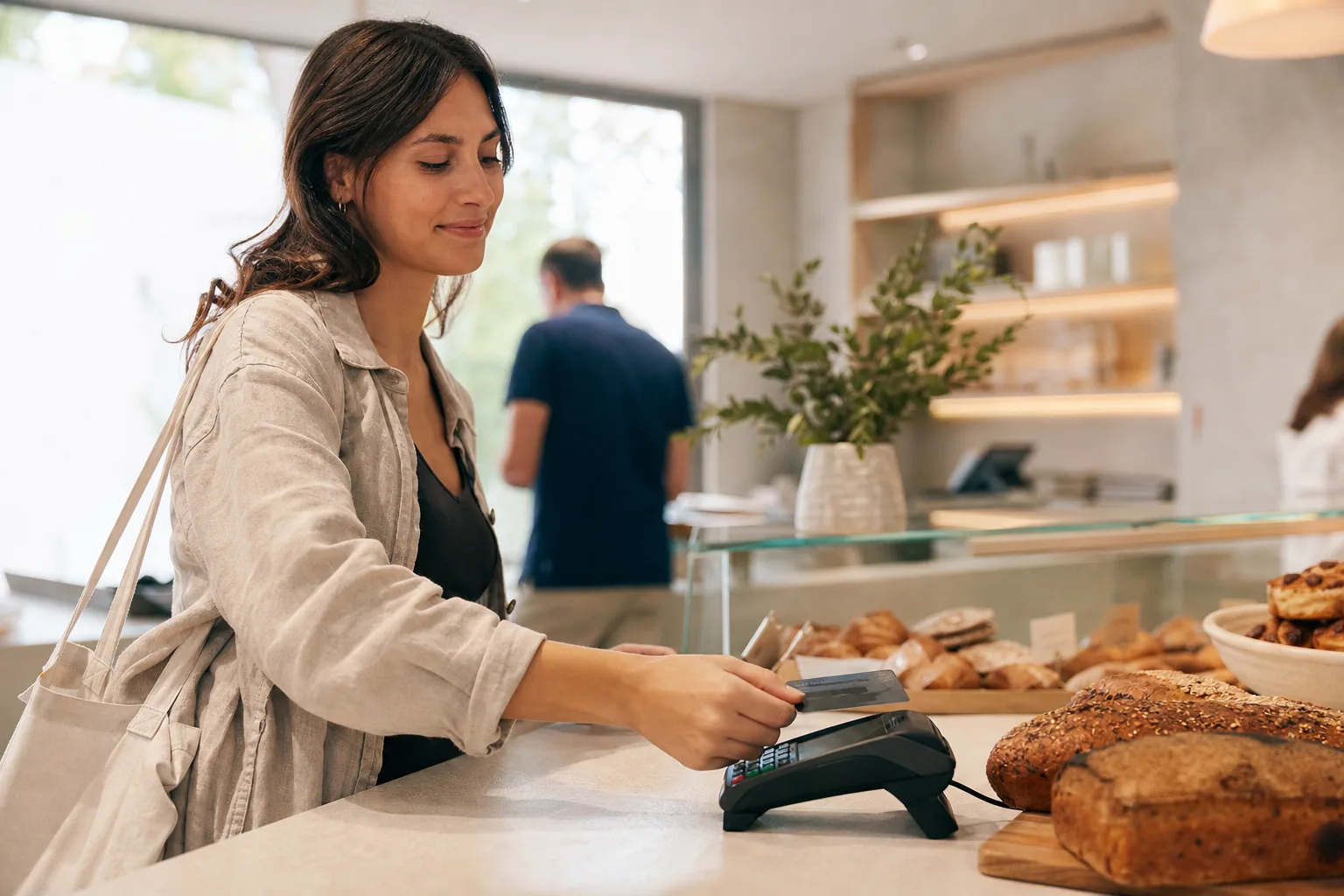
Contactless payment is any payment made by holding a card, phone, or wearable near a reader rather than inserting or swiping. Almost all contactless cards run on NFC and follow the EMV contactless standard, so a one time cryptogram is exchanged and the real card number never travels. QR based payments are contactless in a looser sense, using a camera and a printed code instead of radio. The common thread is that nothing is physically inserted, though most forms still ask the customer to aim at a specific reader.
What counts as contactless
Contactless payment is a category, not a single technology. It covers a plastic card you tap, a phone or watch you hold to a reader, and, in a looser sense, a QR code you scan. What unites them is the absence of a physical connection. Nothing is swiped through a slot or pushed into a chip reader.
The dominant form is the contactless card and its phone equivalent, both of which run on NFC and the EMV contactless rules. QR sits at the edge of the category. It is contactless because there is no insertion, but it is optical rather than radio, so it behaves quite differently in practice.
How a contactless payment clears
For a card or phone tap, the reader emits a short NFC field, the card draws power from it, and the two run the EMV contactless exchange. The card returns a cryptogram, a one time value derived from a secret key, and the reader passes it up to the bank for approval. EMVCo defines this handshake, and it is the reason a tap is accepted with the same trust as a chip.
The customer's part is small. Hold the card or phone to the reader, wait for the confirmation, and the transaction is done. On a phone the wallet adds a fingerprint or face check before it will produce the cryptogram, which is why a phone tap carries an extra layer a bare card does not.
The forms of contactless payment
The forms differ in the technology underneath and in what the customer physically does. Radio based forms need only proximity to a reader. The optical form needs a camera and a clear line of sight to a code.
| Form | Underlying technology | Customer action | Where it is common |
|---|---|---|---|
| Contactless card | NFC radio, EMV rules | Tap the card to the reader | In person retail and transit |
| Phone or watch wallet | NFC radio, EMV rules, a stored token | Tap the device, confirm with biometrics | In person retail and transit |
| QR code payment | Optical; a camera reads a code | Open a camera and scan | Markets, apps, and bill payment |
Why contactless is considered safe
The safety of contactless card payments comes from what is not sent. The card transmits a one time cryptogram rather than the account number, so a captured transaction cannot be reused. EMVCo tokenization goes further for phone wallets, storing a device specific token in place of the card number so that even the credential on the device is not your real one.
The short range of NFC helps too. A field only a few centimetres wide gives an attacker almost nothing to work with, and the deliberate tap makes an accidental payment unlikely. None of this applies in the same way to QR, where the risk moves from the radio to the code itself.
The limits of contactless
For all its convenience, contactless still assumes a specific shape. There is a reader in a fixed place, and the customer aims a card, a phone, or a camera at it. That works cleanly at a staffed counter and less cleanly anywhere the provider is not standing behind a terminal.
It also handles one pairing at a time. One reader, one card, one tap. When several providers are close together, such as a rank of cars or a row of market stalls, contactless has no way to say which provider the customer means. The tap resolves the transaction, but only after the customer has already done the work of choosing and reaching the right reader.
What comes after the tap: proximity payment
Proximity payment keeps the contactless promise, no swipe and no insertion, and removes the aiming step that remains. Rather than reaching for a reader, the customer is simply near the right provider, and presence becomes the trigger.
Parousya's patent US10657515B2 covers the mechanism. A provider broadcasts a short range signal, the customer's phone detects it and identifies the nearest provider, and the payment routes through a central server rather than a terminal. The two devices never connect directly, so there is nothing to pair and no queue at a single reader. The method can sense a broadcast over NFC, Bluetooth, ultra wideband, or WiFi Direct, which lets it work at distances a tap cannot reach.
The divisional patent US11392923B2 adds identification without a payment and third party querying, so presence can be established, and an authorized party can confirm a pairing, without any charge. That is the step past contactless: not a better tap, but no tap at all when the setting does not suit one.
Common questions
- What is contactless payment in simple terms?
- Paying by holding a card, phone, or wearable near a reader instead of swiping or inserting. Most contactless cards use NFC and the EMV standard, exchanging a one time cryptogram so your card number never travels.
- Is a QR code payment contactless?
- In a looser sense, yes. There is no insertion, but QR is optical rather than radio. A camera reads a code, so it needs line of sight and a deliberate scan, unlike the radio tap of a contactless card.
- Is contactless payment secure?
- Yes. The card sends a one time cryptogram, not the account number, and phone wallets store a device token through EMVCo tokenization. The short NFC range and the deliberate tap make interception and accidental payments unlikely.
- What is the difference between contactless and proximity payment?
- Contactless still needs the customer to reach and aim at a specific reader. Proximity payment, covered by patent US10657515B2, treats being near the right provider as the trigger and routes through a server, so no terminal has to be tapped.
- Can contactless tell apart two nearby readers?
- No. Contactless handles one reader and one card at a time and relies on the customer to choose. Resolving which of several nearby providers is meant is the problem the patented proximity method is built to solve.
Sources
- How does tap to pay work?The mechanics of the contactless tap.
- How do QR code payments work?The optical corner of the category.
- What is NFC mobile payment?Paying with a phone wallet.
- Contactless payment, definedThe short definition and related terms.
- Proximity payment vs tap to payPresence against a deliberate tap.
- RetailContactless at the counter, and past it.