
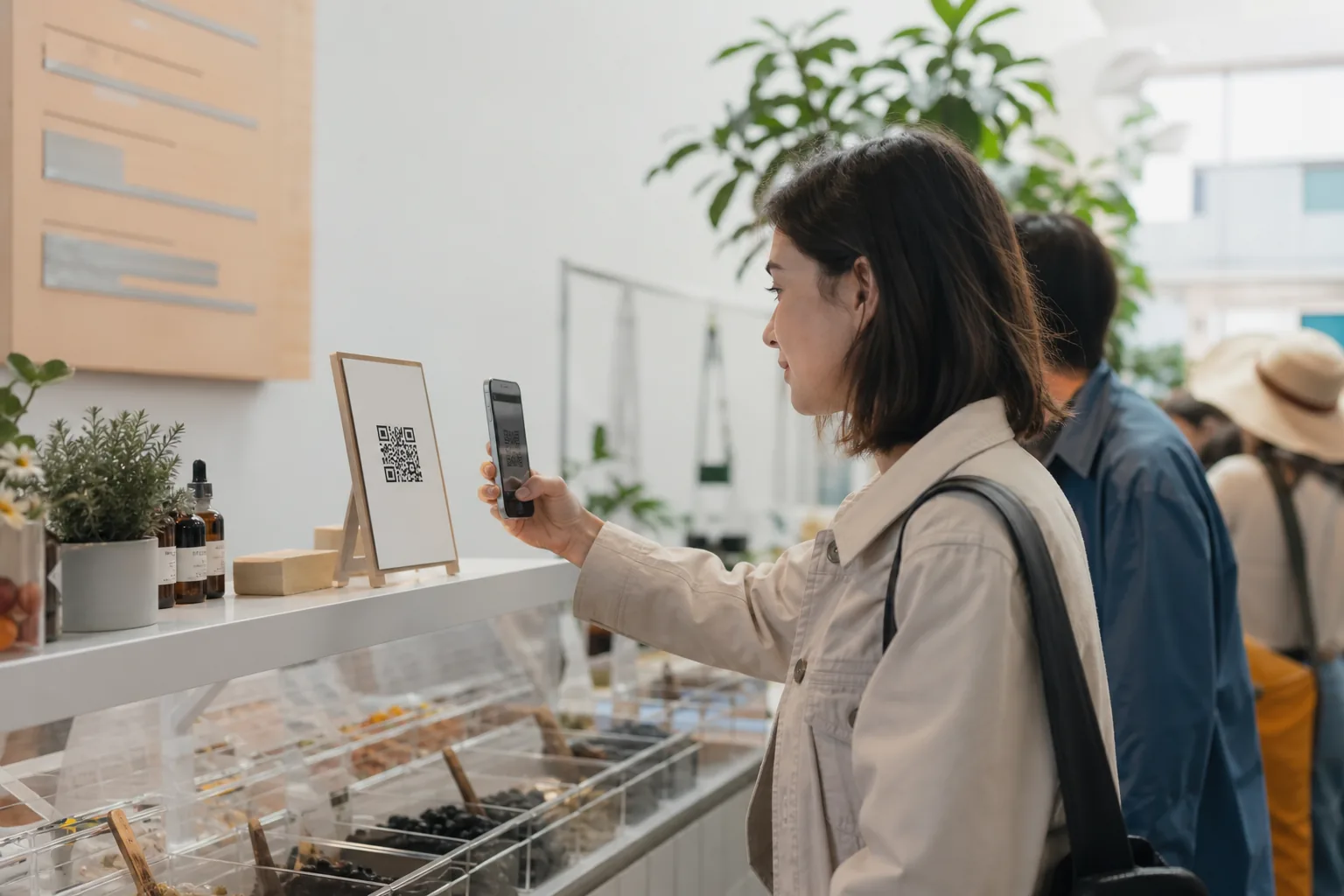
A QR code payment encodes payment information, or a link to it, in a square barcode that a camera reads. Either the customer scans the merchant's code or the merchant scans the customer's, the encoded data identifies the account or the invoice, and the transaction clears over the internet. QR is inexpensive because it needs only a screen or a printout and a camera, but it depends on line of sight and a deliberate scan. GS1 standardizes the QR code format.
What a QR code payment is
A QR code is a two dimensional barcode, standardized by GS1, that stores far more than the stripe of a traditional barcode. In a payment, the code carries the information a payment app needs: an account reference, an invoice, or a link that resolves to one. A camera reads the pattern, the app decodes it, and the payment proceeds.
There are two directions this can run. In the merchant presented mode, the shop shows a code and the customer scans it. In the customer presented mode, the customer's app shows a code and the merchant's scanner reads it. Both end in the same place, with one party's device having read a code the other displayed.
How a QR payment clears
The flow is simple and it leans on the internet. A camera captures the code, the app decodes the payload, and the app contacts the payment provider over a network connection to move the money and return an approval. Without connectivity at the moment of the scan, most QR payments cannot complete, because the code itself is only a pointer, not an authorization.
Codes come in two kinds. A static code is printed once and always encodes the same destination, which is cheap but means the amount is keyed in by hand. A dynamic code is generated per transaction and can carry the exact amount and a one time invoice, which is safer and smoother but needs a screen to display it. The choice between them is a trade between cost and control.
QR code payment versus tap to pay
QR and tap to pay are often mentioned together as contactless options, yet they work on entirely different principles. One is optical and one is radio, and that difference decides how each behaves in practice.
| Dimension | QR code payment | Tap to pay (NFC) |
|---|---|---|
| Technology | Optical; a camera reads a printed or shown code | Radio; an NFC field at a few centimetres |
| Customer action | Open a camera, aim, and scan | Hold the card or phone to the reader |
| Merchant hardware | A screen or a printout, plus a camera | An NFC capable reader |
| Line of sight | Required | Not required |
| Connectivity at payment | Usually needed to reach the provider | The tap itself can often complete without a live link |
Where QR wins and where it strains
QR wins on cost and reach. A payee needs only to print or display a code, and a payer needs only a camera, which every phone already has. That is why QR spread fastest where installing NFC readers everywhere was impractical. It asks very little of the hardware on either side.
It strains on the human factors. The customer has to open a camera, frame the code, and hold steady, and that fails in poor light, at an awkward angle, or on a scratched printout. It is also one code to one payee, so it does not help when many sellers are close together. The scan resolves a payment the customer has already lined up. It does not choose the provider for them.
QR code payment risks
The format itself is neutral, and GS1 defines it plainly. The risk lives in the destination the code points to. A printed code can be covered with a sticker that redirects payment, and a shared image can carry a link to a convincing fake. Because a human cannot read a QR code by eye, the customer is trusting that the square in front of them leads where it claims to.
Dynamic codes reduce the exposure, since a fresh, transaction specific code is harder to swap unnoticed, and good apps show the payee before confirming. But the underlying weakness is structural. An optical pointer to an online destination is only as safe as the destination and the display it appeared on.
Beyond scanning: proximity payment
Proximity payment removes the camera and the aiming that QR depends on. Instead of pointing a phone at a printed square, the customer is simply near the right provider, and presence does the work the scan used to do.
Parousya's patent US10657515B2 covers the mechanism. A provider broadcasts a short range signal, the customer's phone detects it and identifies the nearest provider, and the payment routes through a central server so the two devices never connect directly. There is no code to swap, because there is no code, and the method can pick the right provider among several rather than relying on the customer to have found the correct square. The divisional patent US11392923B2 adds identification without a payment, so a match can be confirmed by presence before any charge. Where QR points a camera at a destination, the proximity method senses the provider directly and lets the server carry the rest.
Common questions
- How does a QR code payment actually work?
- A camera reads a QR code that encodes an account or invoice, or a link to one, the app decodes it, and the payment clears over the internet. Either the customer scans the merchant's code or the merchant scans the customer's.
- Do QR payments need the internet?
- Usually, yes. The code is a pointer, not an authorization, so the app has to reach the payment provider over a network to move the money. Without connectivity at the moment of the scan, most QR payments cannot complete.
- Are QR code payments safe?
- The format is neutral, but the destination is the risk. A printed code can be overlaid to redirect payment, and a shared image can hide a fake link. Dynamic, transaction specific codes and apps that show the payee first reduce the exposure.
- Is QR or tap to pay better?
- They differ. QR is cheap and needs only a camera and a code, but it depends on line of sight, a steady scan, and connectivity. Tap to pay is faster and needs no aiming, but it requires an NFC reader. The setting decides.
- How is proximity payment different from scanning a code?
- There is no code and no camera. Patent US10657515B2 senses a provider's broadcast, identifies the nearest provider, and routes payment through a server, so nothing is aimed at and there is no square to swap or misread.
Sources
- How does tap to pay work?The radio alternative to a scan.
- What is contactless payment?The category QR sits at the edge of.
- What is NFC?The radio behind the tap.
- Contactless payment, definedThe short definition and related terms.
- Tap to pay vs QR codeRadio tap against an optical scan.
- RetailCodes, taps, and what comes next at the counter.