
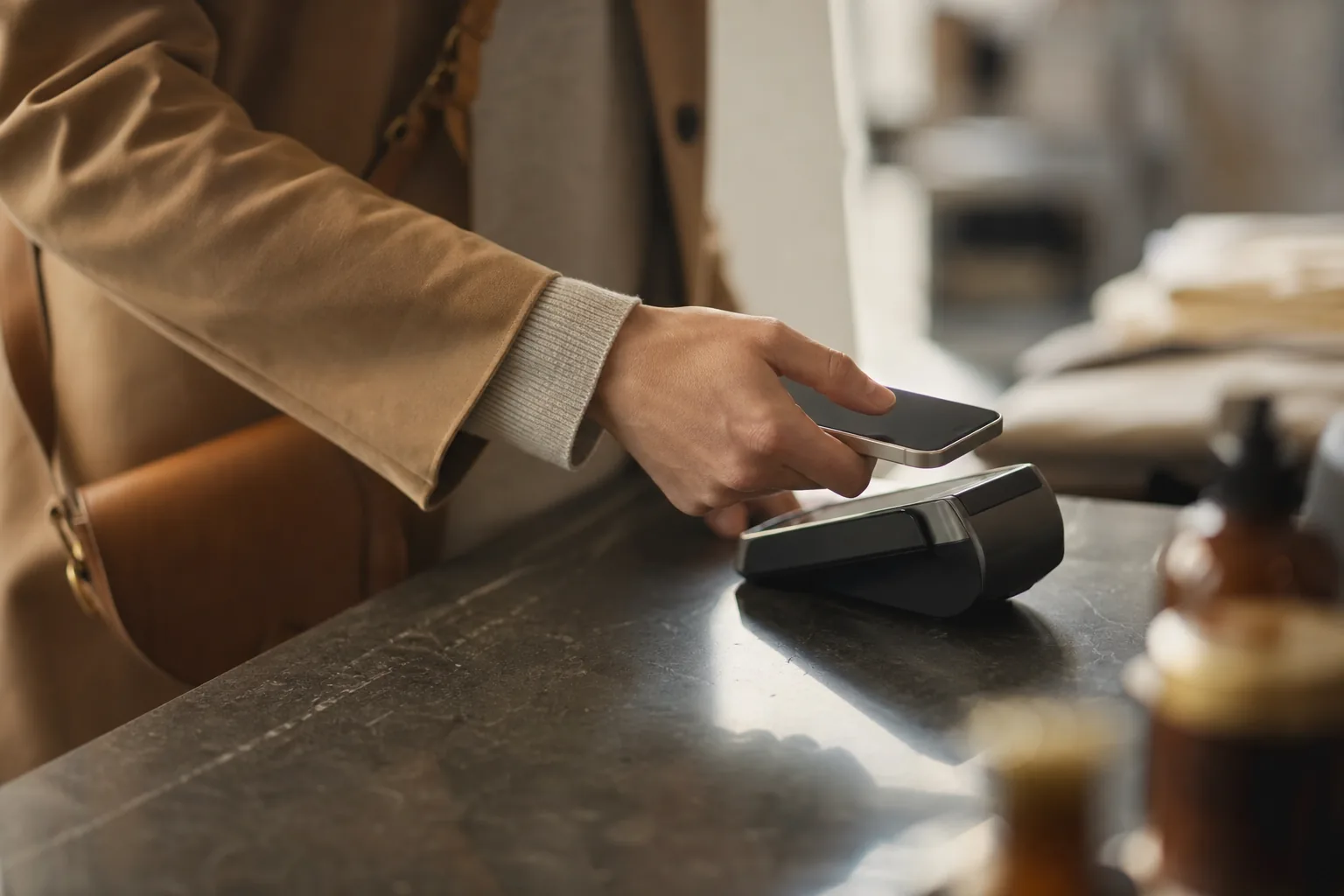
NFC mobile payment is paying with a phone or wearable by holding it to a contactless reader, using the same NFC radio and EMV contactless rules as a tap to pay card. The wallet stores a device specific token instead of your real card number, and a fingerprint or face check authorizes each tap. Apple Pay and Google Wallet are the best known examples, though the NFC transport and the tokenization underneath them are open standards. The result is a tap that reveals less than the physical card would.
What NFC mobile payment is
NFC mobile payment is what happens when a phone or watch stands in for a contactless card. The device carries a wallet, the wallet holds your card as a secure credential, and holding the device to a reader completes a payment over NFC. Apple Pay and Google Wallet are the familiar names, and both are wallets built on the same underlying radio and payment rules.
It is worth being clear that the wallet brand is not the technology. NFC is an open standard from the NFC Forum, the EMV contactless rules come from EMVCo, and tokenization is a shared scheme. A wallet is a convenient front end over those rails, not a private system of its own.
How a phone tap works
When you bring a phone to a reader, several things happen in quick order. The reader's NFC field wakes the phone's payment function. The phone checks that you are present, usually with a fingerprint or a face scan, and only then releases a payment credential. That credential produces an EMV cryptogram, a one time value, which the reader forwards to the bank for approval.
The card details sit in a protected part of the phone and are not handed to the reader. Depending on the device, this is a dedicated secure element or an equivalent protected service. Either way, the sensitive material stays on the phone, and what crosses the NFC gap is a cryptogram that is worthless once used.
The biometric gate is the practical difference from a plain card. A card in a wallet will tap for anyone holding it. A phone will not authorize without the owner, and the stored credential can be switched off remotely if the phone is lost.
Tokenization: why the phone never shares your card number
The security of an NFC mobile payment rests on tokenization, a scheme EMVCo defines. When you add a card to a wallet, the wallet does not store your account number. It stores a device specific token, sometimes called a device account number, that stands in for the card on that one device.
Every transaction then uses a one time cryptogram derived from that token, not the account number itself. So the card number is absent twice over: it is not kept in the wallet, and it is not sent in the payment. If the token is ever exposed, it can be revoked and reissued without touching your actual card. This is why a phone tap is often treated as more private than presenting the card in person.
NFC wallet, contactless card, and QR wallet compared
Placing the phone wallet beside a contactless card and a QR wallet app shows what the mobile tap actually adds. All three avoid inserting a card, but they differ in what they store, how they authenticate, and whether they lean on connectivity at the moment of payment.
| Method | Credential stored | Authentication | Reader works offline |
|---|---|---|---|
| Phone NFC wallet | A device specific token, not the card number | Fingerprint or face, per tap | Often; the tap can clear without a live link |
| Contactless card | The card and its keys on the chip | Usually none below a limit | Often, within contactless rules |
| QR wallet app | An account reference shown as a code | App login or device unlock | No; a scan usually needs connectivity |
The rails behind the tap
It helps to see the layers. NFC is the transport, the radio that carries the exchange. EMV is the payment protocol, the rules that make a cryptogram trustworthy. Tokenization is the security layer, keeping the real card number out of both the wallet and the transaction. Beneath all of it are the card networks and the bank, which settle the money.
The wallet sits on top and ties these together into a single tap. Understanding the layers explains why the same phone can pay at almost any contactless reader regardless of the wallet brand. The reader speaks NFC and EMV, and every compliant wallet speaks the same.
The next layer: presence instead of a tap
An NFC mobile payment is a strong, private way to pay, and it still assumes a reader within a few centimetres. The customer has to find the terminal and present the phone to it. That is fine at a counter and awkward where there is no terminal, or where many providers are close together and the phone would have to know which reader to approach.
Parousya's patented proximity method treats presence itself as the trigger. Patent US10657515B2 covers how a provider broadcasts a short range signal, the customer's phone detects it and identifies the nearest provider, and the payment routes through a central server so the two devices never connect directly. It can sense that broadcast over NFC, Bluetooth, ultra wideband, or WiFi Direct, which lets it work past the reach of a tap and still resolve the single right provider.
This complements NFC wallets rather than replacing them. Where there is a terminal, a tap is perfect. Where there is not, or where the crowd makes choosing a reader ambiguous, the method identifies the provider by presence and lets the server carry the payment. The divisional patent US11392923B2 adds identification without a payment and third party querying, so a match can be confirmed, and verified by an authorized party, before any money moves.
Common questions
- What is NFC mobile payment?
- Paying with a phone or wearable by holding it to a contactless reader, using the same NFC radio and EMV rules as a tap to pay card. The wallet stores a token instead of your card number and requires a biometric check per tap.
- Is NFC mobile payment the same as Apple Pay or Google Wallet?
- Those are wallets built on NFC mobile payment, not separate technologies. Both ride on the NFC radio, the EMV contactless rules, and EMVCo tokenization, which are open standards rather than the property of any one wallet.
- Is paying with a phone safer than a card?
- Generally, yes. The phone stores a device specific token, not your card number, sends only a one time cryptogram, and will not authorize without a fingerprint or face check. A lost phone will not tap for someone else, and its token can be revoked.
- Does an NFC mobile payment need internet?
- Not always at the moment of the tap. The EMV contactless standard allows many taps to clear without a live link, settling the record afterward. Whether a given tap can go offline depends on the card, the reader, and the bank.
- How does proximity payment relate to NFC mobile payment?
- It extends it past the reader. A tap needs a terminal within centimetres, while patent US10657515B2 treats presence near the right provider as the trigger, senses the broadcast over several radios, and routes through a server so no terminal is needed.
Sources
- What is NFC?The radio the wallet runs on.
- How does tap to pay work?The tap, card or phone.
- What is contactless payment?The wider category of no insertion payments.
- Tap to pay, definedThe short definition and related terms.
- Tokenization, definedHow a token replaces the card number.
- RetailPhone taps and their successors at the counter.