
The short answer
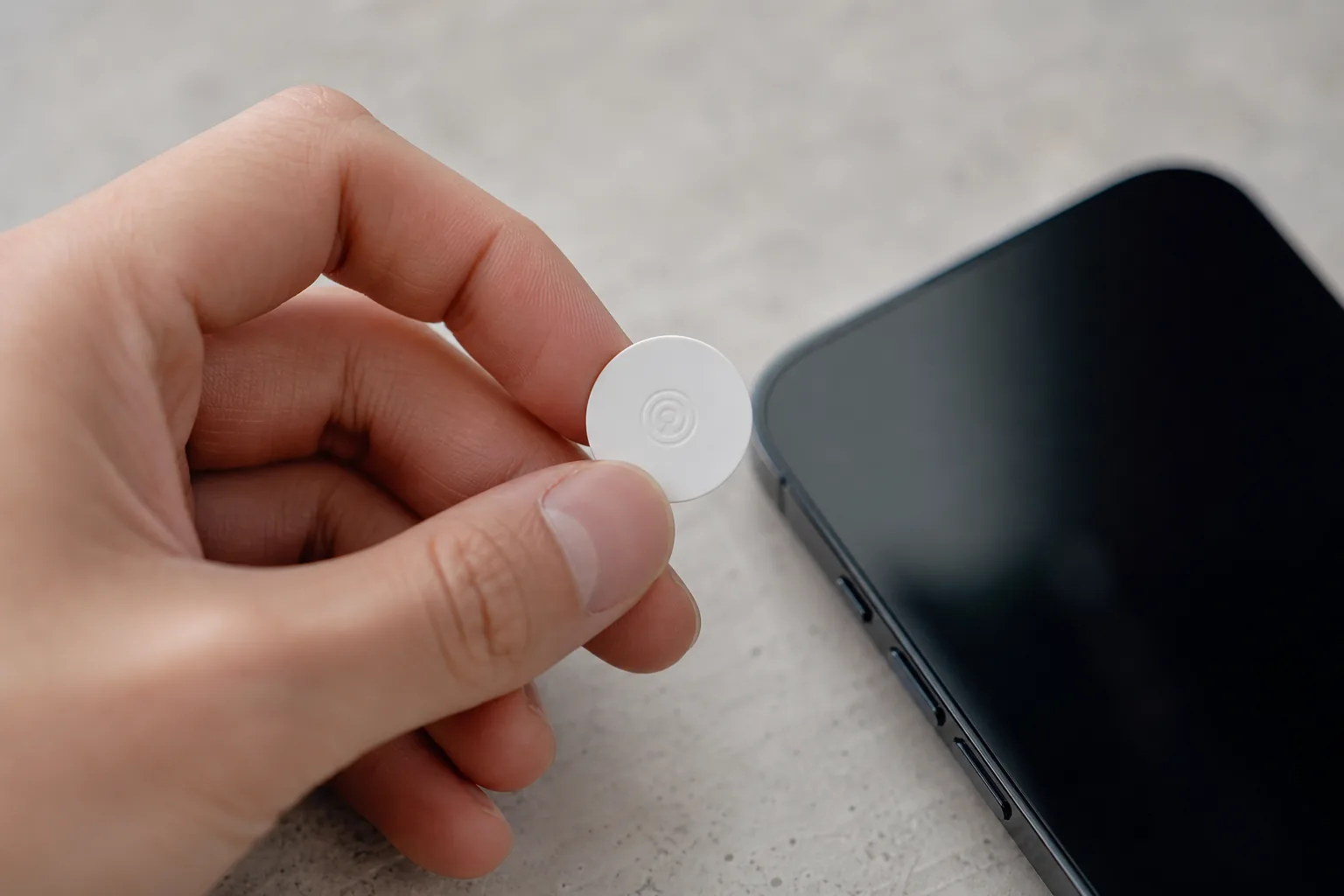
An NFC tag is a tiny chip with a small antenna and no battery. When you hold an NFC phone close, the phone field powers the chip and reads the data it holds, which is often a web link, a network setting, or a command. The tag is the passive half of near field communication, and your phone is the active reader.
What is inside an NFC tag
A tag is about as simple as electronics get. It has three parts and no power of its own.
The reader does the powering. Your phone generates the field, the tag draws from it, and only then does the chip respond. This is why a plain sticker with no battery can still answer a tap. A tag is a short range, high frequency case of RFID, and that reader powered behavior is the defining trait the NFC Forum describes.
- An antennaA thin coil of wire, usually printed flat, that both harvests energy and carries the signal.
- A chipA small integrated circuit that wakes up when the reader field reaches it.
- A little memoryA few bytes to a few kilobytes, enough for a link, an identifier, or a short record.
Active reader, passive tag
A tag never starts anything. It waits to be read. That makes it very different from the radios that reach out on their own. Ranges and power behavior here follow the qualitative descriptions from the NFC Forum, the Bluetooth SIG, and GS1, which maintains the QR and barcode standards.
| Device | Power source | Who starts the exchange |
|---|---|---|
| NFC tag | None, powered by the reader | Nothing, it waits |
| NFC phone | Its own battery | The phone, by tapping |
| BLE beacon | A small battery | The beacon, broadcasting |
| QR code | None, it is just ink | The camera, by scanning |
From reading a tag to being recognized
A tag is honest but dumb. It broadcasts the same bytes to any phone that taps it, which is exactly right for a link and exactly wrong for identity or payment. Anyone can read it, and it cannot tell who is reading.
Recognizing a specific person needs the opposite arrangement. In the proximity method patented by Parousya Technologies, the phone senses a provider and the transaction routes through a central server, so the two devices never connect directly and nothing is sent until the person acts. The parent patent US10657515B2 covers that proximity identification and server routed payment. The divisional US11392923B2 adds identifying a person without a payment and standalone device claims, which is what lets the method confirm who arrived rather than simply hand out a link.
So a tag answers what is written here. The method answers who is standing here.
Common questions
- What is an NFC tag?
- A small chip with an antenna and no battery that stores a little data. A phone powers it over a short range field and reads it on contact.
- Do NFC tags need a battery?
- No. The tag draws power from the reading phone field, which is why a plain sticker can respond to a tap.
- Can I write to an NFC tag?
- Many tags are rewritable, so a phone app can store a link or a command on them. Some are locked once written so the data cannot change.
- Are NFC tags secure?
- A basic tag broadcasts openly to any reader, so it is fine for public links but not for identity or payment. Those need a server routed method that confirms who is involved.
- How far away can an NFC tag be read?
- Only a few centimetres. The very short range is defined by the NFC Forum and is what makes a tap deliberate.